
Why does your resume get no responses even if it passes ATS?
If your resume gets no responses, a strong checker score cannot tell you why. The score may help you improve content, but it does not reveal the employer’s requirements, applicant pool, review decisions, or changing hiring plans. Review your targeting and evidence alongside the file itself, without treating silence as proof that you did something wrong.
An applicant tracking system (ATS) helps employers manage applications. Saying a resume “passes ATS” often means it scored well in a separate checker, not that an employer accepted it through a known test. Keep that distinction clear before choosing what to fix.
Separate a readable file from a competitive application
A resume can contain extractable text and clear sections while offering weak evidence for a particular role. It may describe relevant experience, yet still compete with candidates who have more of what the employer needs. A checker cannot see the full applicant pool or every part of the decision.
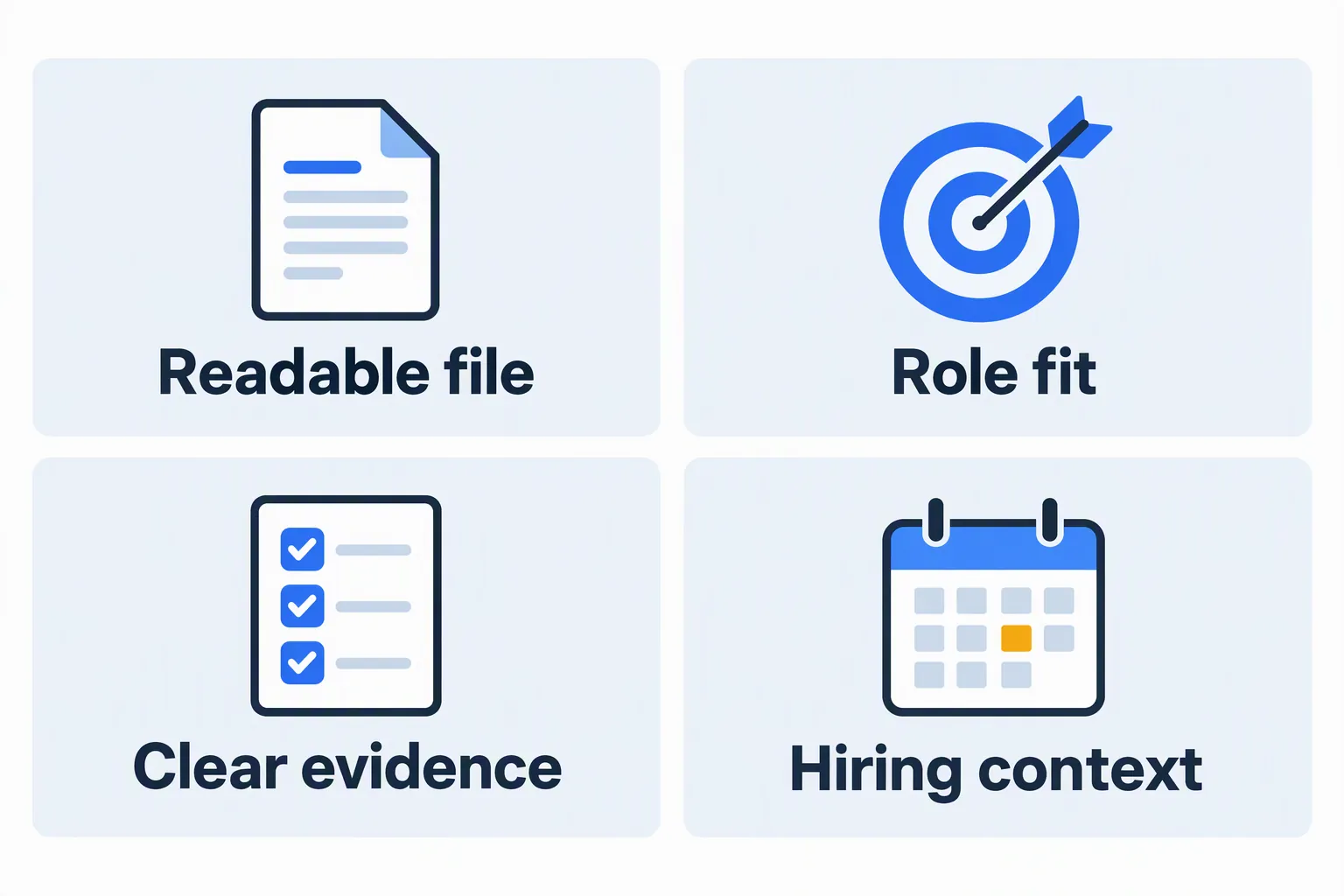
This site’s content analysis does not measure the original PDF’s columns, fonts, or page geometry. Its local checks inspect extracted text separately. A clean report is useful feedback, but it cannot establish that a specific employer’s parser or reviewer will handle the application as you expect.
Start by checking whether key details survive and whether any application fields are wrong. Once those are accurate, repeated changes to margins or headings may be less useful than reviewing the roles and evidence you choose.
Check the work behind the job title
Two openings with the same title can ask for different work. An operations analyst role may emphasize warehouse reporting, financial forecasting, or software implementation. Read the responsibilities and requirements rather than treating the title as enough evidence of fit.
Separate required qualifications from preferences. Notice specific tools, licenses, work settings, schedule requirements, and levels of responsibility. Be honest about a requirement you do not meet while recognizing that a preferred item is not always a stated condition of eligibility.
Greenhouse documents automatic rules based on application answers, including a required commercial driver’s license example. This does not reveal what happened to your application, but it explains why good formatting cannot override a configured requirement.
Create a short comparison in your notes: what the posting asks for, where your resume proves it, and what is genuinely missing. If the match relies on skills you have not used, consider a role closer to your present experience instead of adding those skills to the file.
Make relevant evidence easy for a person to find
A reader should not have to infer your fit from a broad skills list. Put your strongest relevant contributions where they are easy to locate, and connect each tool or capability with work you completed. Keep role titles, employers, and dates accurate.
Harvard’s resume guidance recommends tailoring to the position and using specific, fact-based language. These are practical writing choices, not promises that a revision will produce an interview. The goal is to make the evidence clear enough to assess.
Fictional example: make support work visible
Retail Supervisor. Managed store duties and customer needs.
Retail Supervisor. Resolved customer order issues, documented follow-up, and trained new staff on escalation steps.
For a support-oriented opening, this revision makes relevant work visible without changing the real role title or inventing professional software-support experience.
Do not replace every bullet with the wording of the posting. A long list of familiar phrases can still give little evidence of what you did. Explain the action, setting, and useful result or output.
Tailor the emphasis, keeping the facts stable
A base resume can support several related roles, but each version should make the relevant evidence easy to find. Keep the same factual history while selecting different bullets, ordering skills by relevance, or writing a focused summary.
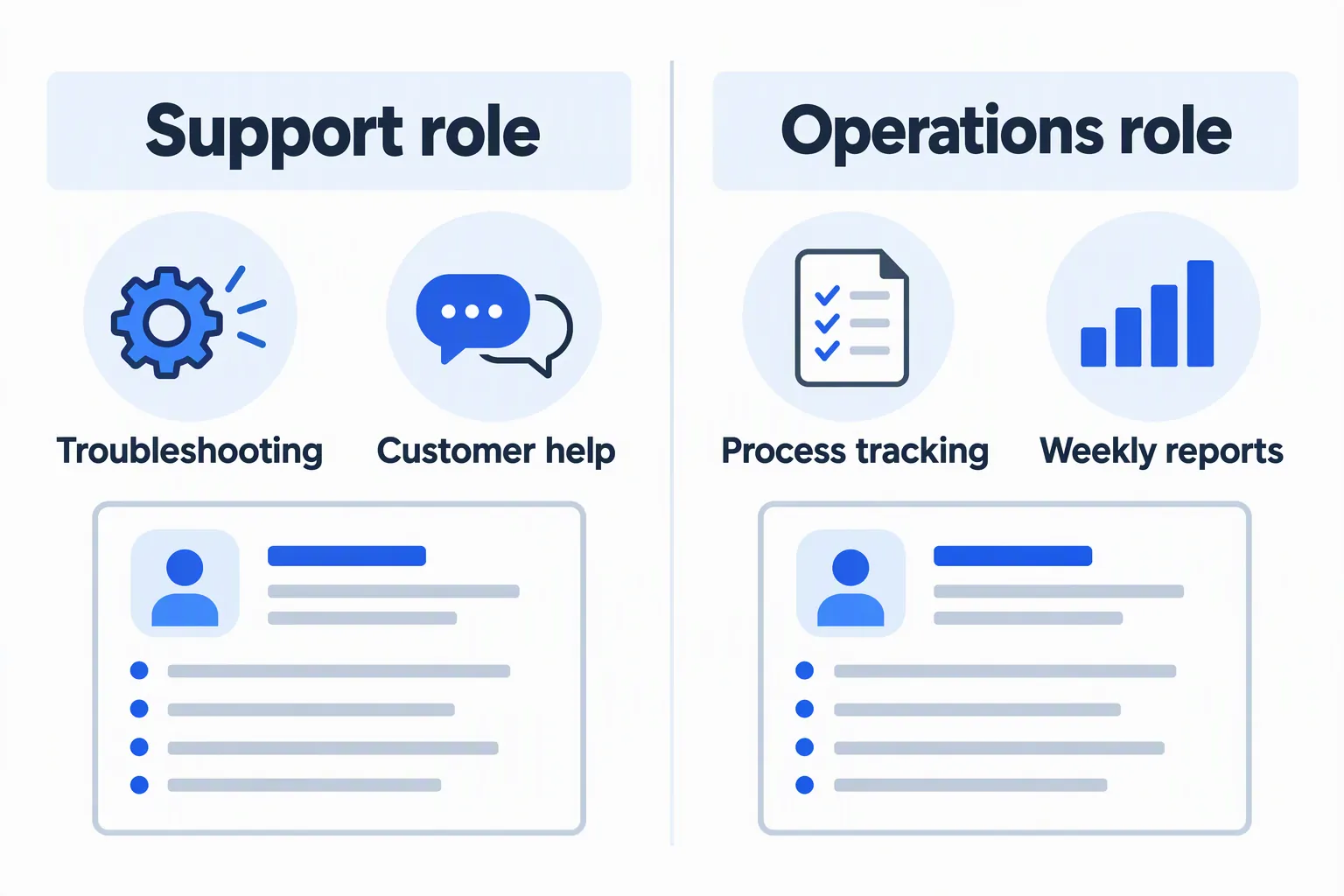
In the fictional example, a candidate has done customer issue resolution and weekly process reporting. The support application leads with troubleshooting and follow-up. The operations application gives reporting and process tracking more space. Neither version needs to invent a new role.
Fictional example: replace a broad summary
Motivated professional seeking opportunities to use a wide range of skills.
Operations coordinator with experience preparing weekly order reports and tracking follow-up across warehouse teams.
This version gives a reader a concrete starting point. It is appropriate only when those facts describe the applicant’s actual background.
If your applications span unrelated fields, one generic resume may make none of the fits clear. Choose a few coherent role types and build honest versions around the evidence you have for each. A narrower target is a review choice, not a rule that you must abandon all stretch applications.
Review application choices and hiring context
Check whether the opening is still listed on the employer’s own careers page and whether the location or schedule works for you. A copied posting on another site may provide less current information. Follow the official application instructions and avoid treating an old listing as a guaranteed active search.
Hiring plans can change, and some searches take longer than expected. Internal candidates, budget decisions, or competing applicants are possible explanations for silence, not diagnoses you can make from a checker report. Do not assume all of them apply to a particular employer.
If an application confirmation provides a timeline or contact method, use it to plan a reasonable follow-up. If the employer says not to contact recruiters, respect that instruction. A single concise follow-up can ask about the process without claiming the employer owes a response or sending repeated messages.
Keep the original posting and submission date in your own records. They help you distinguish a recent application from one that has been waiting for a while and remind you which resume version you sent.
Check practical details beyond keywords
Verify your email address, phone number, and any relevant portfolio link. Make sure the saved file opens and that the link destination shows the work you intend to share. An outdated project page or missing contact digit can be a fixable problem even when a score is high.
Read the finished resume from a person’s perspective: can you find the role, the work, and the contribution without decoding vague language? Ask a trusted reader to explain what kind of job the resume appears to target. Their answer can reveal an unclear emphasis, though it still cannot explain an employer’s decision.
Check that application answers match the document. An accurate resume paired with a mistaken dropdown answer creates an avoidable inconsistency. Review the submitted information carefully rather than assuming the upload replaced every form field.
Look for patterns without overreading a small sample
Keep a simple record of the role type, stated requirements, resume version, application date, and stage reached. Separate no response from a rejection, an interview, or an opening that was withdrawn. Those outcomes contain different information.
If you receive interviews for one role type but little response for another, review the second type’s requirements and your evidence. If interviews happen but offers do not, resume formatting alone is unlikely to answer the whole problem. Interview preparation or the match itself may deserve attention.
A few applications are not enough to isolate the effect of one edit, because employers and openings differ. Avoid declaring that a new font “worked” after one response or that a particular score guarantees failure. Use patterns to choose questions to investigate, not as proof of cause.
Use Democruit for a focused next draft
Democruit describes guided tailoring around job-description keywords, skills gaps, and responsibilities, with suggestions under your control. That can help you review emphasis for a selected role. It does not supply missing qualifications or guarantee responses.
From your checker report, “Fix in Democruit” transfers the structured resume and feedback. Sign up or log in and complete account consent to save them, then review the suggested edits. Keep titles, dates, skills, and metrics faithful to your actual experience.
Choose your next useful change
- Verify the file, contact details, links, and application answers.
- Compare the target role’s real requirements with evidence you can support.
- Make the most relevant work easy to find, without adding invented skills.
- Record role types and outcomes so you can review patterns over time.
- Treat employer silence as uncertainty rather than proof of an ATS failure.
Your next step
When your resume gets no responses, review the full application instead of chasing a higher score alone. Check accuracy, role selection, relevant evidence, and patterns while leaving room for uncertainty in the employer’s process.
Run the free ATS resume check to review your PDF before applying. For more on selecting relevant experience for a role, read Democruit’s resume tips article.
Sources and product behavior checked October 4, 2026. Illustrations and worked examples are fictional; employer systems and requirements vary.
Frequently asked questions
Why am I getting no responses with a high ATS score?
A checker score does not reveal the employer’s decision or the other applicants. Review role fit, clear evidence, application details, and possible hiring-context differences alongside the file itself.
Should I rewrite my entire resume after every rejection?
Not automatically. Check whether the role required different evidence or whether the application had a concrete error. Keep accurate facts stable and revise the emphasis when that makes your fit clearer.
Can tailoring guarantee more interviews?
No. Tailoring can make relevant experience easier to assess, but it cannot control the applicant pool or employer decisions. Use suggestions to improve clarity without inventing qualifications.
Does no response mean a person never saw my resume?
You usually cannot tell from silence alone. Some applications may be screened earlier and others may be reviewed without a response; a checker report cannot determine which occurred.