
How do you write resume bullet points with measurable results?
Write resume bullet points with measurable results by naming the action you took, the scope of the work, and an outcome you can support. A useful number explains your contribution; it should not be added just to make a bullet look stronger. When no reliable outcome metric exists, use truthful scope or a specific qualitative result instead.
An applicant tracking system (ATS) helps employers manage applications, but software is not the only audience. A person needs to understand what you did, why it mattered, and how much of the work was yours. Specific evidence helps answer those questions without turning every task into a dramatic success story.
Build the bullet around action, scope, and outcome
Start with a verb that describes your contribution: prepared, resolved, tested, coordinated, or built. Add the work’s scope, such as the number of reports, the team served, or the process you handled. Then describe what changed or what the work enabled.
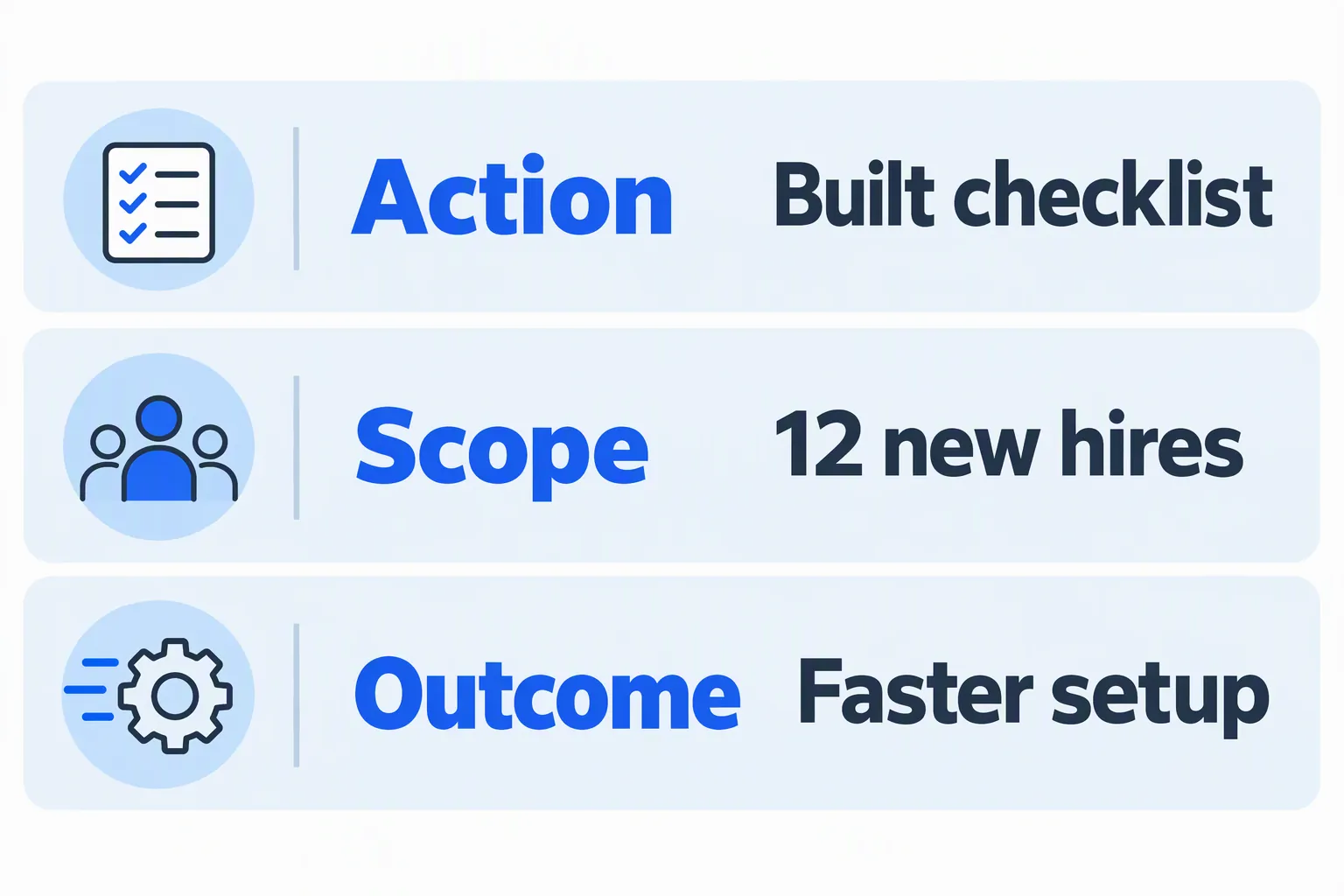
The order can vary. “Reduced report preparation time by updating the spreadsheet workflow” leads with the outcome; “Updated the spreadsheet workflow, reducing report preparation time” leads with the action. Choose the version that reads clearly and stays accurate.
Harvard’s resume guidance recommends specific, active, fact-based language that quantifies and qualifies work. That is a writing principle, not a requirement that every bullet include a percentage. A precise task and audience can be useful evidence even without a numeric improvement.
Distinguish an outcome from the size of the work
An outcome describes a change or result, such as less time spent on a task. Scope describes the work’s size, such as processing invoices for several departments. Both can make a bullet clearer, but they answer different questions.
“Reviewed 80 invoices each week” is scope. “Reduced duplicate invoices after adding a review step” describes an outcome. If you cannot verify the reduction, keep the scope and the action instead of adding a guessed percentage.
Fictional example: make administrative work specific
Responsible for invoices.
Reviewed about 80 supplier invoices each week for three departments, flagging duplicate entries before approval.
The revised bullet shows volume, audience, and the purpose of the check. “About” marks an estimate; use it only if your records or recollection support that scale.
The work does not need to generate revenue to matter. Reliable documentation, accurate processing, resolved support issues, and clear training materials can all support a team. Describe the contribution in language relevant to the role you want.
Calculate changes from the correct starting point
If a task took 50 minutes before your change and 40 minutes after it, the saving is 10 minutes. Divide the saving by the original 50 minutes: 10 ÷ 50 = 0.20, or a 20% reduction. These are fictional task measurements, not a statistic about hiring.
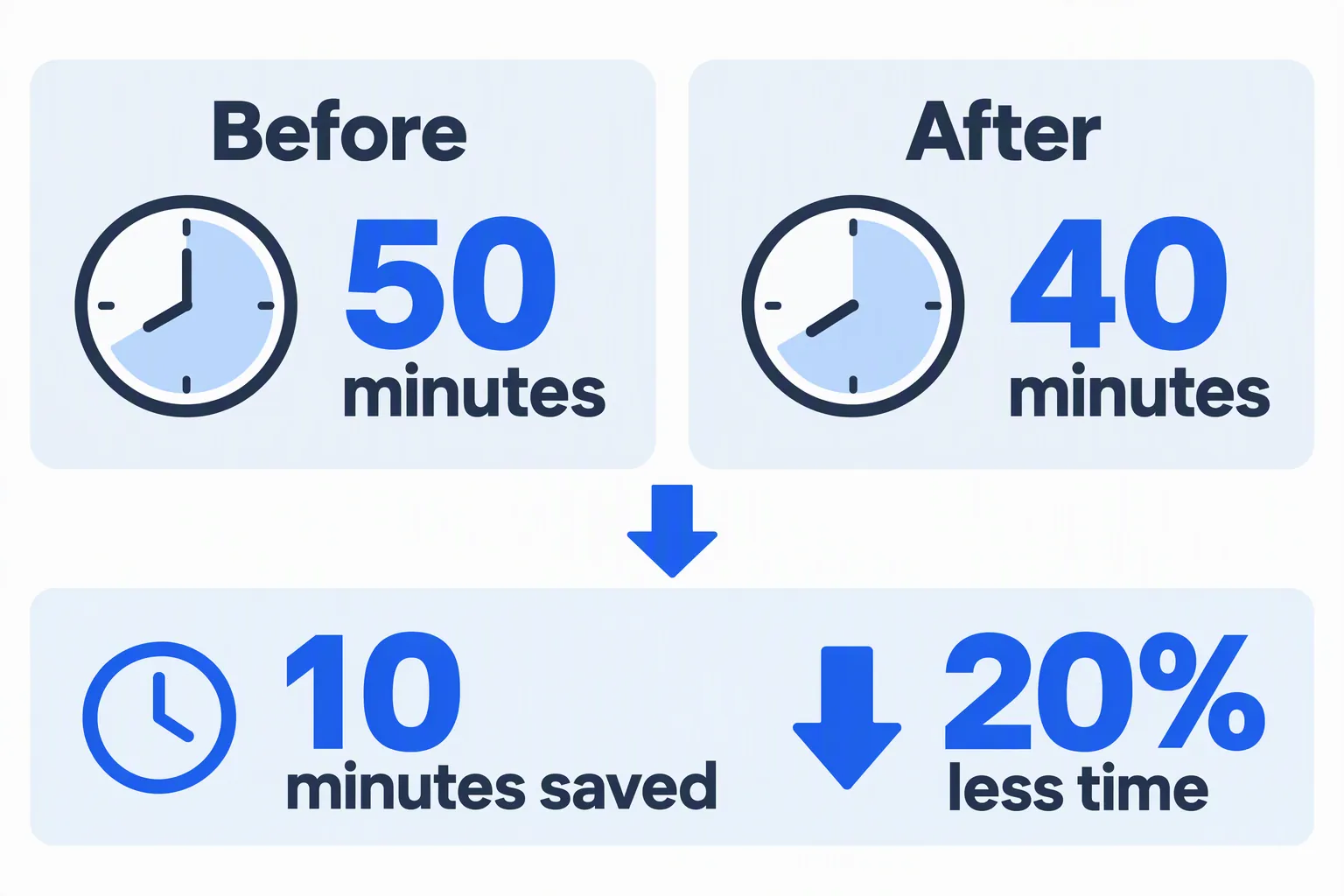
Use comparable measurements. One easy task after the change and one unusually hard task before it do not make a fair comparison. Explain whether the times are averages, typical observations, or measured totals, and use the same basis on both sides.
Percentages and percentage points differ. If an error rate goes from 5% to 4%, it falls by one percentage point, or 20% relative to the starting rate. Avoid “reduced errors by 1%” if that wording hides which calculation you mean.
Fictional example: state the measurement clearly
Made reporting much faster.
Rebuilt the weekly report template, reducing average preparation time from 50 to 40 minutes over six reporting cycles.
The revision provides the baseline, new value, and observation period. If the change was a team effort, adjust the verb or attribution to reflect your part.
Find evidence you are allowed to use
Look at your own permitted records: project summaries, performance notes, calendars, report schedules, or an approved portfolio. They may help you verify dates, task volume, audience, and outcomes. Do not expose confidential employer or customer data to make a bullet more impressive.
When exact financial results are private, a permitted description of scope may be enough. You can describe the process you supported or the type of deliverable without disclosing a client’s identity. If you cannot safely or accurately support a figure, leave it out.
Keep a private note explaining each metric’s source and calculation. You do not need to attach that note to the resume, but you should be able to explain the claim in an interview. If the number is an estimate, use restrained language and avoid false precision.
Give team results fair attribution
A team result can belong in your resume when you explain your contribution. “Led” is appropriate only if you led the work. “Contributed,” “implemented,” or “tested” can describe a substantial part without claiming responsibility for everything.
Fictional example: connect your part to the team result
Increased product adoption by 30%.
Wrote onboarding instructions and tested the signup flow for a team launch that increased active accounts from 200 to 260.
The revision identifies the candidate’s work and places the result at team level. The fictional account increase is 30%, but the wording avoids claiming the candidate alone caused it.
Do not force a causal claim when several things changed at once. An increase after a project may be relevant context, yet does not establish that your change caused the whole increase. Choose wording you can defend without needing to retract it later.
Use meaningful evidence across different roles
For customer support, consider the types of issues handled, channels used, documented follow-up, or a verified service measure. For operations, consider the process, frequency, teams served, or a measured delay. For technical work, explain what you built, tested, or maintained and who used it.
Fictional example: show a support contribution
Helped customers and used the CRM.
Resolved billing questions by phone and email, recording next steps in Salesforce so the support team could continue follow-up.
This example shows a tool, action, and practical purpose without an invented satisfaction score or ticket count.
Fictional example: describe a technical project
Worked on a Python project.
Built a Python script to check missing fields in a public transit dataset and produce a summary for a class analysis.
The revised bullet labels the setting and output. It does not present coursework as paid production work or claim unmeasured efficiency.
Choose examples that match the target role. A sales figure may be less useful than a clear troubleshooting example when applying to support work. Keep the facts stable while changing which relevant contributions receive the most space.
Write a strong bullet when no metric exists
Name the problem, your action, and the useful output. “Created a handover checklist for weekend staff so open cases had a recorded owner and next step” explains a practical contribution. It does not need a guessed time saving to be understandable.
If you do not know the result, state what you completed. Avoid vague claims such as “dramatically improved efficiency” that imply evidence you cannot provide. A concrete deliverable is stronger than an exaggerated adjective.
Use one main idea per bullet. If a line contains three projects, several tools, and unrelated outcomes, split it or select the most relevant part. Remove filler such as “responsible for” when a direct verb explains the work better.
Review the claim before chasing a score
This checker may identify opportunities to strengthen content and impact. Its feedback does not verify your metrics, employer records, or causal claims. The original PDF’s layout is also outside the content analysis, so review both the wording and the finished document.
Verify each result bullet
- Can you explain the action and your own contribution?
- Is the number an outcome, scope, or estimate, and is that clear?
- Are the baseline, time period, and calculation accurate?
- Can you discuss the claim without exposing confidential information?
- Does the evidence help explain your fit for the target role?
Your next step
Resume bullet points with measurable results should make your work clearer, not larger than it was. Keep the action specific, the attribution fair, and every number tied to evidence you can explain.
Run the free ATS resume check to review your PDF before applying. For more on choosing and organizing experience bullets, read Democruit’s guide to resume bullet points.
Sources and product behavior checked October 4, 2026. Illustrations and worked examples are fictional; employer systems and requirements vary.
Frequently asked questions
Does every resume bullet need a number?
No. Use an accurate number when it explains scope or an outcome. A specific action and useful output are better than a fabricated metric.
Can I estimate a result?
Use an estimate only if you have a reasonable basis and label it appropriately. Avoid false precision, and be ready to explain how you arrived at the figure.
Can I include a team achievement?
Yes, if you make your own contribution clear. Describe the team result as context rather than implying that you personally caused the whole outcome.
Will measurable results guarantee a higher ATS score?
No. This checker offers content feedback, but it cannot verify your figures or guarantee a particular score or interview. Choose evidence for its truth and relevance, not solely to satisfy a suggestion.